On August 14, I had the opportunity to attend an informative meeting of the Fort Bend Levee Coalition and Fort Bend County Drainage District at Houston Methodist Sugar Land Hospital. The program brought together national, state and local experts to discuss weather forecasting, levee safety, flood insurance, emergency management and long-term disaster mitigation.
Although many of these subjects are highly technical, their purpose is deeply personal: protecting lives, homes, businesses and the communities we have worked so hard to build.
Continuing Judge Bob Hebert’s Legacy
The meeting began with a meaningful tribute to former Fort Bend County Judge Bob Hebert and his lasting influence on flood protection and emergency preparedness.
Judge Hebert helped lead the study of the Brazos River that resulted in higher flood elevations and the subsequent raising of local levees. Those improvements proved extremely important when Hurricane Harvey struck in 2017. He also supported the update of the county’s Drainage Criteria Manual, adopted in 2011, and revisions to Fort Bend County’s floodplain regulations in 2014.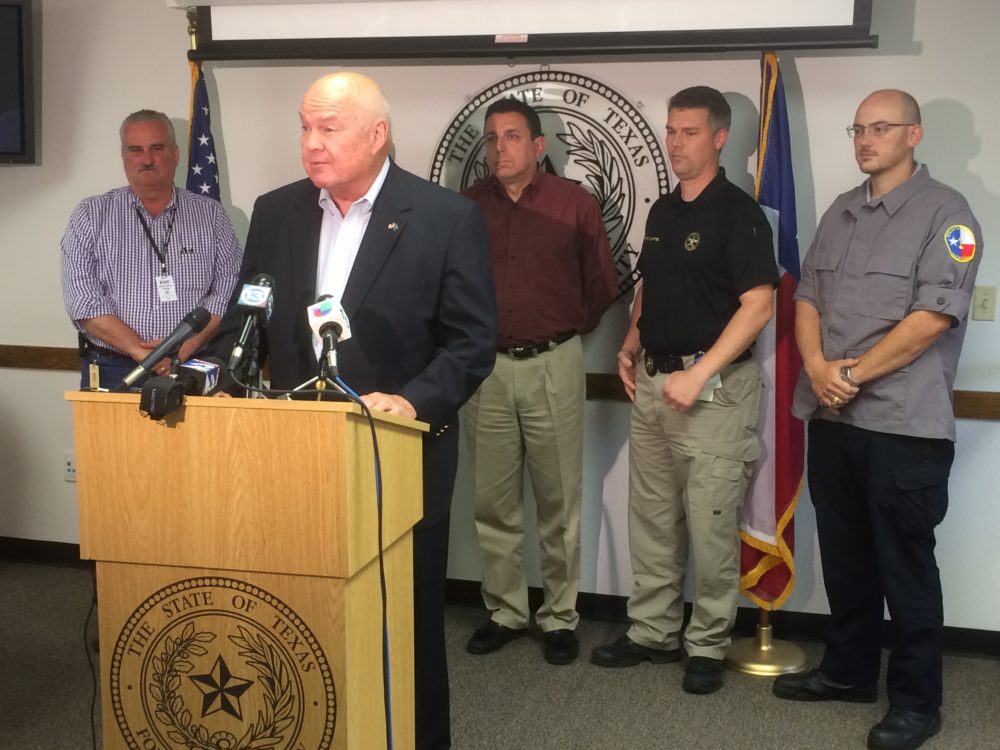
During his tenure, Judge Hebert served as emergency management director through Hurricane Ike in 2008, the spring floods of 2015 and 2016, and Hurricane Harvey. In 2013, he directed the Drainage District to begin working with local levee districts on inspections consistent with U.S. Army Corps of Engineers standards. In 2015, he encouraged the county to provide free continuing education for levee district directors and operators.
This meeting was reportedly the 45th educational event conducted since that initiative began.
Judge Hebert also championed the additional foot of freeboard that became known locally as the “Fort Bend foot.” Once that higher level of protection was established, he believed it should remain the county’s standard.
It was a powerful reminder that the decisions of strong leaders can continue protecting a community many years later.
Preparing for a Potentially Wet El Niño Winter
Dr. David Novak, director of the National Oceanic and Atmospheric Administration’s Weather Prediction Center, discussed the developing El Niño and its possible effects on Texas.
El Niño is a naturally occurring change in Pacific Ocean temperatures and atmospheric circulation that can influence weather patterns around the world. Dr. Novak explained that a very strong El Niño could increase the likelihood of a wetter winter across Texas, although seasonal outlooks do not predict precisely where or when individual storms will occur.
That distinction is important. Long-range outlooks help emergency managers understand broad risks, while local National Weather Service offices issue the specific watches and warnings that communities rely upon during an event.
Dr. Novak also highlighted advances in NOAA’s flood-inundation mapping. These tools can model where floodwater may reach, identify structures potentially affected and show whether roads or bridges may be underwater. Nationwide coverage is expanding rapidly, and Fort Bend County was among the earlier areas included.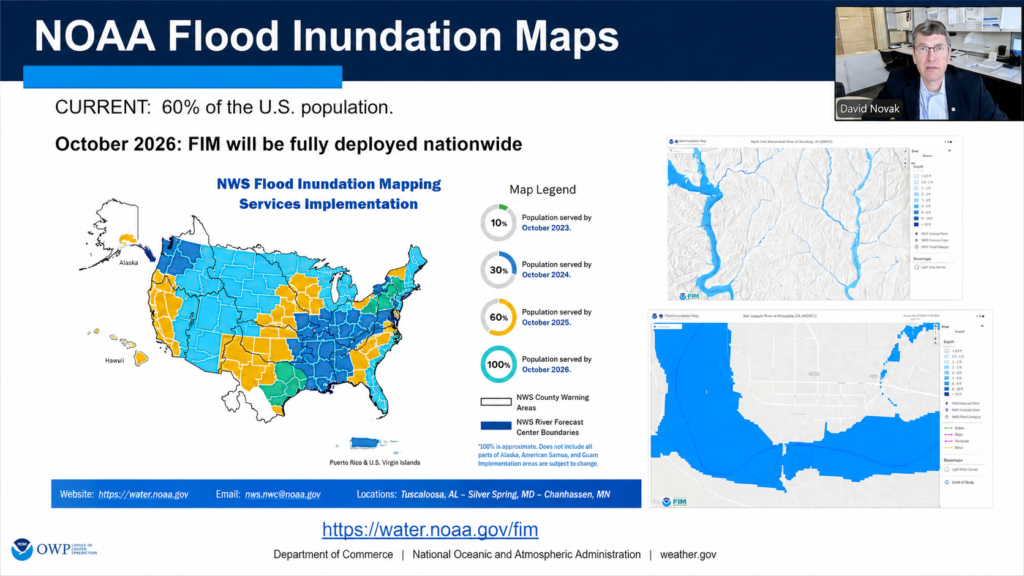
Dr. John Nielsen-Gammon, Texas State Climatologist, Regents Professor at Texas A&M University and director of the Southern Regional Climate Center, provided additional Texas-focused perspective on El Niño, extreme weather and the uncertainty that must always be considered when interpreting seasonal forecasts.
The message was clear: forecasts cannot eliminate uncertainty, but better information gives local officials more time to prepare and make sound decisions.
Strengthening Levee Safety
Rick L. Hauck, technical manager with the U.S. Army Corps of Engineers Levee Safety Center of Expertise, provided an update on the National Levee Safety Program and the Corps’ work in Fort Bend County.
The voluntary Levee Review program provides participating levee owners with a federally funded field visit and screening-level risk assessment. The review considers how a levee could be loaded during a flood, its condition and performance, possible failure modes, and the consequences if water reaches or exceeds the system’s capacity.
The process produces findings and recommendations that can help levee districts:
- Guide operations and maintenance
- Prioritize capital improvements
- Identify needed engineering studies
- Document system conditions
- Strengthen future funding and mitigation requests
The Corps has already completed reviews of two Fort Bend County levee systems. A review of the Sugarstone system is expected to be submitted in September, while reviews of the Sienna Plantation North and South systems are moving forward.
The meeting also demonstrated the importance of maintaining accurate information in the National Levee Database. Levee owners and operators can review their system information, request corrections and use the Levee Inspection System to document observations and conditions in the field.
Accurate information is essential not only for safety and planning but potentially for flood-insurance calculations.
Flood Insurance and the Levee Quality Factor
One of the most significant discussions concerned FEMA’s levee quality factor and its possible effect on National Flood Insurance Program premiums.
Updated levee assessments may result in a more favorable quality factor for some properties protected by well-maintained systems. Based on current examples, participants discussed the possibility of reductions of approximately 15% to 30% in the flood-insurance premium portion of a policy. Those savings are not guaranteed, and FEMA’s rating methods and factors can change.
Fort Bend officials and the Levee Coalition are currently waiting for FEMA to incorporate updated information from the National Levee Database. The Corps has completed its portion of the process, and local leaders are continuing to advocate for FEMA to update its records.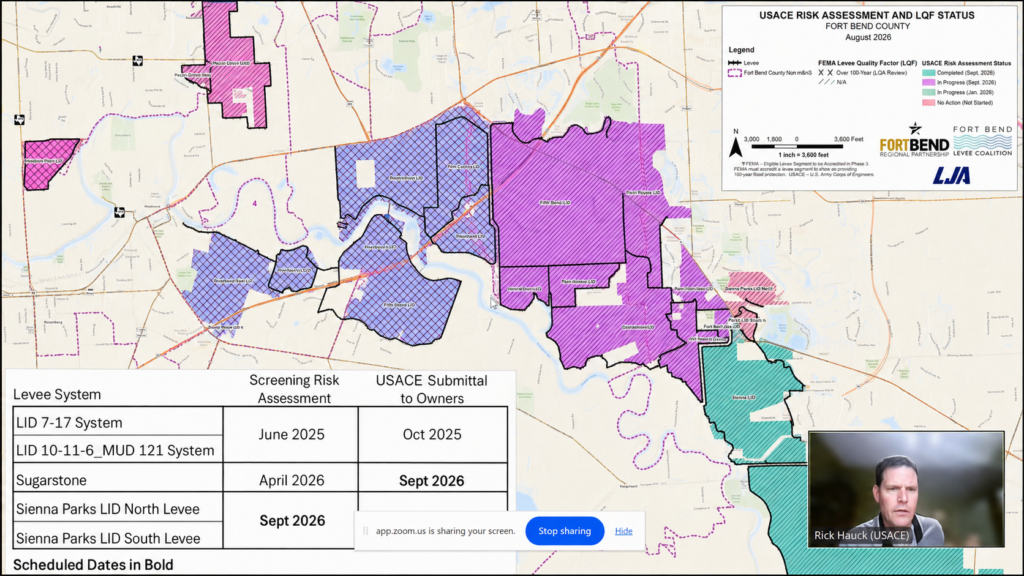
The discussion also revealed why premiums can vary considerably between nearby homes. FEMA may consider factors such as relative elevation, distance from a stream or other body of water, and even the exact location at which a structure is plotted in its system. These variables can sometimes produce results that seem inconsistent to residents.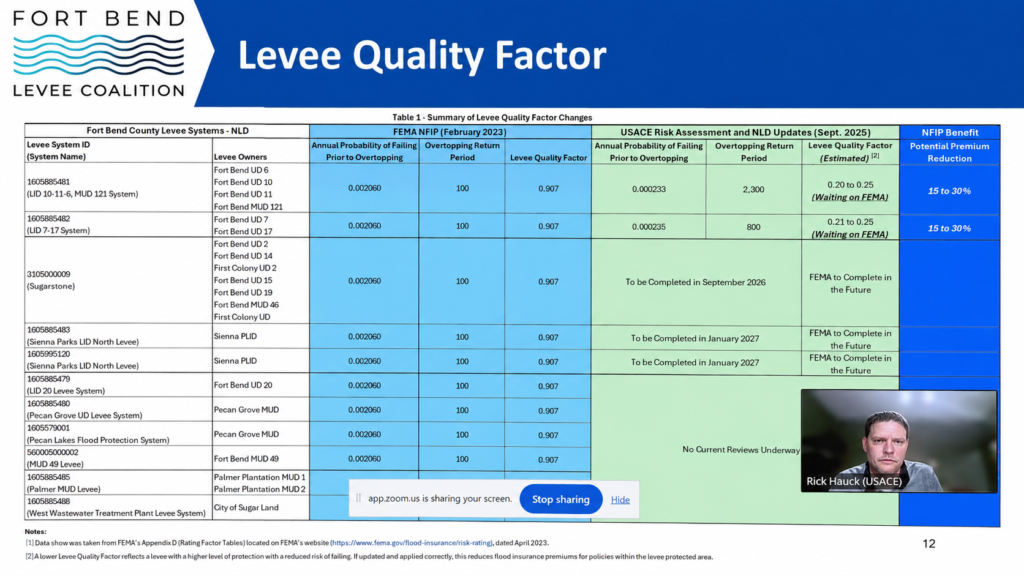
This is an area where transparency, current data and continued advocacy are badly needed.
Emergency Management Begins Locally
Chief Stevee Franks, regional section chief for Texas Division of Emergency Management Region 4, explained how local, state and federal agencies work together before, during and after a disaster.
Her central message was that every disaster begins and ends locally. State and federal resources can provide essential assistance, but local officials and emergency-management personnel remain responsible for their communities long after outside resources leave.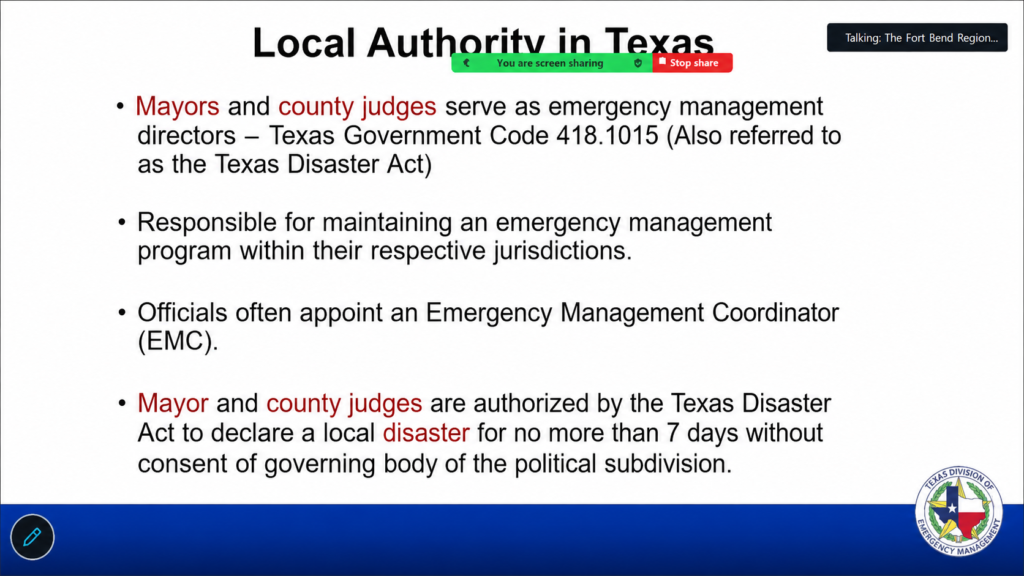
Chief Franks emphasized the importance of documenting every expense and every action taken during a disaster. Labor, equipment use, debris removal, emergency protective measures and damage to public facilities must be properly recorded if local governments expect to receive reimbursement.
She also discussed mitigation—the work performed before the next disaster to reduce its impact. Mitigation can include levees, drainage improvements, detention facilities, generators, bridge improvements, warning systems and the acquisition of repeatedly flooded properties.
Studies have estimated that every dollar invested in mitigation can save between $6 and $13 in future recovery costs. That makes mitigation more than an engineering issue; it is also responsible financial stewardship.
Protecting Fort Bend’s Future
As County Treasurer, I understand the importance of safeguarding taxpayer dollars. I also recognize that responsible stewardship includes supporting thoughtful investments that can prevent much greater losses in the future.
Fort Bend County’s approach to flood protection is built upon decades of planning, local investment, engineering expertise and cooperation among levee districts, drainage officials, emergency managers and community leaders. We must continue updating our information, maintaining our infrastructure and preparing for the next severe-weather event before it appears on the radar.
I appreciate the Fort Bend Levee Coalition, Fort Bend County Drainage District, Houston Methodist Sugar Land Hospital and all the speakers who shared their expertise. I am especially grateful to the levee district directors, engineers, operators and emergency-management professionals whose work often occurs quietly but is essential to the safety of our community.
Preparedness is not a one-time project. It is an ongoing responsibility—and one of the most important investments we can make in Fort Bend County’s future.