Growing up in New Orleans, you learn early that history is never very far away. It is in the names of our streets, the architecture of our neighborhoods, the churches that anchor our communities, the traditions handed down through generations, and the monuments that quietly tell the stories of those who came before us.
Some of those stories are famous throughout America. Others deserve to be rediscovered.
One of my favorites is the remarkable story of Margaret Haughery, an Irish immigrant, widow, entrepreneur, philanthropist, and champion of orphaned children who became so beloved by the people of New Orleans that, after her death, they erected a monument to her that occupies an extraordinary place in American history.
Margaret Haughery’s monument is recognized as the first publicly erected statue honoring a woman in the United States. The Dictionary of Irish Biography distinguishes it from earlier monuments erected through private efforts or on private property and identifies Margaret’s as the first publicly erected statue of a woman in America. (DIB)
That distinction says something powerful about Margaret—and about New Orleans.
From Orphan to the “Bread Woman of New Orleans”
Margaret Gaffney Haughery was born in County Leitrim, Ireland, on Christmas Day in 1813. Her family immigrated to America when she was a child, but tragedy followed her early life. By the age of nine, Margaret had lost both of her parents and was herself an orphan.
As a young woman, she married Charles Haughery and eventually came to New Orleans. More heartbreak followed. Within a short period, she lost both her husband and her infant daughter.
She could easily have been defeated by those losses.
Instead, the experience appears to have created within Margaret a lifelong compassion for children who had lost their own families.
The Historic New Orleans Collection records that Margaret initially worked as a laundress and shared what little extra money she earned with the Sisters of Charity, who cared for orphaned children. Eventually she was able to purchase two cows and establish a small dairy business. (VOP Omeka)
From those humble beginnings grew an extraordinary New Orleans business story.
Margaret expanded her dairy operations and eventually entered the bakery business. She became a successful entrepreneur at a time when opportunities for women—much less an Irish immigrant woman with little formal education—were severely limited.
Her bakery became prosperous, and Margaret became known throughout New Orleans as the “Bread Woman of New Orleans.”
But accumulating money was never the end of the story.
What made Margaret extraordinary was what she did with it.
Business Success With a Purpose
Margaret used the wealth generated by her businesses to care for people who could not care for themselves.
She became deeply involved in supporting New Orleans orphanages and helped finance institutions including St. Elizabeth’s Asylum, St. Teresa’s Asylum and St. Vincent’s Asylum. Her support for orphaned children continued throughout her life. (VOP Omeka)
Her charity was not simply writing an occasional check.
Margaret became personally identified with the institutions and children she helped. She provided food. She raised money. She helped finance buildings. She offered business judgment and assistance. Her reputation for practical wisdom grew to the point that people from different walks of life reportedly sought her advice.
The Catholic Encyclopedia’s account of her life describes her as becoming an integral part of New Orleans and notes that people throughout the city affectionately referred to her simply as “Our Margaret.” (New Advent)
That may be one of the greatest compliments a community can give someone.
Not Mrs. Haughery.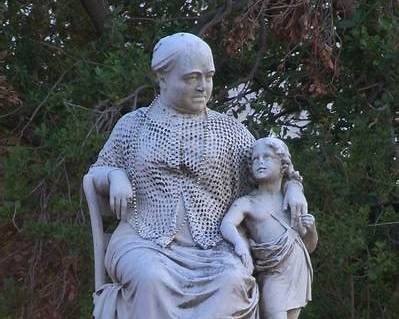
Not a title.
Not an office.
Just Margaret.
Everyone knew who that meant.
A Funeral That Became a Civic Event
When Margaret Haughery died on February 9, 1882, New Orleans mourned.
Her passing was treated not simply as the death of a successful businesswoman but as the loss of someone who had become part of the moral fabric of the city. Historical accounts describe a remarkable funeral attended by people from across New Orleans society, with civic and religious leaders participating in the observances. (New Advent)
She had begun life with almost nothing.
She had been orphaned.
She had lost a husband and child.
She had possessed little formal education.
Yet through work, determination, faith, business ability and generosity, she built enterprises capable of generating substantial wealth—and then directed much of that wealth toward people who needed help.
When she died, her charitable commitment continued. The Historic New Orleans Collection notes that she left her fortune to charitable causes. (VOP Omeka)
New Orleans decided that such a life should not be forgotten.
The Statue of “Margaret”
Citizens began raising money for a monument.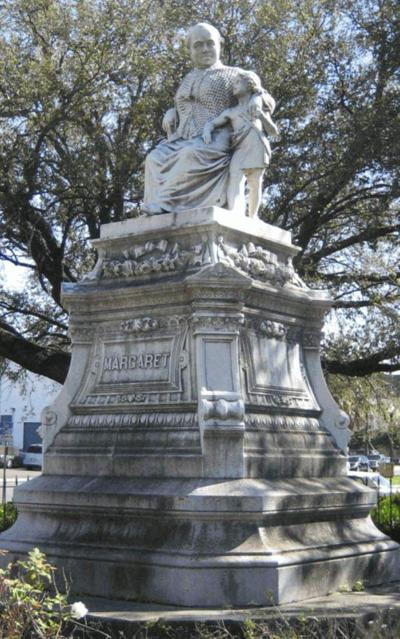
Sculptor Alexander Doyle was commissioned to create it, and the completed marble monument depicts Margaret seated with a child beside her—a fitting representation of the woman whose name had become synonymous with care for the city’s orphans.
On July 9, 1884, the statue was unveiled at what became known as Margaret Place, at the intersection of Camp and Prytania Streets. Children representing the city’s orphanages participated in the dedication, and former Louisiana Governor Francis T. Nicholls was among those involved in the ceremonies. (DIB)
Perhaps the most remarkable feature of the monument is the inscription.
It does not require a lengthy explanation of who she was.
The pedestal bears simply:
MARGARET
That was enough.
The people of New Orleans knew.
A Landmark in American Women’s History
The monument represents something larger than the life of one New Orleanian.
The Dictionary of Irish Biography describes Margaret’s memorial as the first publicly erected statue to a woman in the United States, as well as the first monument to a female philanthropist and the only known public statue honoring a baker. (DIB)
The Smithsonian American Art Museum’s sculpture inventory similarly identifies the Haughery monument as one of America’s earliest outdoor sculptures honoring a woman and the first nonreligious New Orleans statue honoring a woman. (SIRIS)
Think about the significance of that.
America was filled with statues honoring generals, presidents, political leaders and military heroes.
Yet in New Orleans, citizens chose to raise a public monument to a businesswoman whose greatest distinction was helping children.
She commanded no army.
She held no elected office.
She possessed no prestigious academic degree.
She had no powerful family name to open doors for her.
Her monument was earned through service.
A Lesson That Still Matters
As a New Orleans native, I believe Margaret Haughery’s story captures something special about the city I grew up in.
New Orleans has always been a place where people from different countries, cultures, religions and circumstances have created lives for themselves—and, at their best, have turned their success into something that strengthens the larger community.
Margaret’s story also carries a lesson that applies far beyond Louisiana.
Success is measured not only by what we accumulate, but by what we do with the responsibility that comes with it.
As Fort Bend County Treasurer, I spend much of my professional life thinking about stewardship. Government stewardship concerns public money, accountability and our obligation to safeguard resources entrusted to us by taxpayers.
Margaret Haughery practiced another form of stewardship.
She took the resources entrusted to her through years of hard work and business success and used them to improve the lives of others—particularly children who faced the same terrible circumstance she had experienced as a child.
More than 140 years after the unveiling of her monument, Margaret still sits quietly at Margaret Place in New Orleans.
Beside her stands a child.
Below her is a single name.
MARGARET.
For generations of New Orleanians, nothing more needed to be said.
And for this New Orleans native, hers remains a story worth telling.
— Bill Rickert
Fort Bend County Treasurer
New Orleans Native