Transportation infrastructure is one of those areas where federal policy quickly becomes a local responsibility.
That was the central theme of an especially timely session I attended at the 2026 Texas Association of Counties Legislative Conference in Austin: “Miles of Opportunity: Reauthorization, Federal Investment, and the Road Ahead for Texas Counties.”
The session was moderated by William Chapman, TAC Legislative Consultant for Federal Issues, and featured Eryn Hurley, Chief Government Affairs Officer for the National Association of Counties (NACo), and Grayson County Commissioner Josh Marr. TAC designed the discussion around an important reality: Texas counties maintain more road miles than counties in any other state, making the coming federal surface transportation reauthorization especially consequential for Texas.
Texas Counties Are Major Infrastructure Owners
The numbers presented during the session put the responsibility of Texas counties into perspective.
According to the NACo data presented:
- Texas counties own approximately 46% of the state’s road miles.
- Counties own approximately 19% of Texas bridges.
- Texas counties reported approximately $5 billion in infrastructure expenditures and about $3 billion in transportation expenditures.
- Texas has approximately 322,100 total road miles and more than 56,000 bridges statewide.
These are not abstract statistics.
County roads and bridges connect neighborhoods, businesses, farms, schools, emergency services and major transportation corridors. They move employees to work and products to market. They also frequently provide the first and last miles connecting residents and businesses with state highways and the interstate system.
That is why decisions made in Washington about transportation formulas, bridge programs, planning dollars and eligibility rules eventually matter to taxpayers in places like Fort Bend County.
Nationally, NACo reports that counties own and operate about 44% of all public road miles, demonstrating why counties have such a significant stake in federal transportation policy.
A Major Federal Transportation Deadline Is Approaching
The current federal surface transportation authorization under the Infrastructure Investment and Jobs Act (IIJA) expires September 30, 2026. Congress therefore faces the task of reauthorizing the federal programs that support roads, bridges, transit and other transportation infrastructure.
One of the major proposals now under consideration is the BUILD America 250 Act — Building Unrivaled Infrastructure and Long-term Development for America’s 250th Act.
The bipartisan proposal would authorize approximately $580 billion over five years, from fiscal years 2027 through 2031, for highways, roads, bridges, transit and rail systems. The House Transportation and Infrastructure Committee advanced the legislation in May by an overwhelmingly bipartisan 62-2 vote.
As of the conference, however, the legislation still awaited action by the full House, while the Senate had not yet released its own comprehensive surface transportation bill.
That means the conversation is not finished.
In fact, this is precisely when county involvement matters most.
Some Important Wins for Counties
The presentation highlighted several provisions in the House proposal that would strengthen programs counties rely upon.
One of the most significant is the Bridge Formula Program.
The proposal would increase that program from approximately $5.5 billion per year to $9 billion annually, for a total of about $45 billion over five years. It would also create a 25% set-aside for locally owned bridges and increase the off-system bridge set-aside from 15% to 20%.
For county governments, that is significant.
Federal transportation policy can sometimes concentrate resources on major state or interstate facilities even though residents depend every day on locally owned roads and bridges. Establishing stronger local bridge provisions helps recognize that county infrastructure is part of the national transportation network.
Another important program discussed was the Surface Transportation Block Grant Program, or STBG.
The proposal would increase STBG’s share of certain federal highway formula funds to 31%, compared with 28.74% under the current law. NACo describes STBG as the formula program that has historically benefited counties the most. The proposed five-year funding level is approximately $74.7 billion.
The proposal also maintains Safe Streets and Roads for All, with approximately $3.75 billion over five years, while establishing a 30% rural set-aside and directing a larger portion of the program toward construction projects.
These are the kinds of federal funding mechanisms that can translate into real projects on the ground.
Planning Dollars Matter Too
One important point from the session was that infrastructure funding is not only about construction.
Before a road is widened or a bridge replaced, somebody must identify the need, conduct engineering, develop the project, coordinate with other jurisdictions, meet federal requirements and position the project for funding.
That makes transportation planning resources extremely important.
The BUILD America 250 proposal would provide approximately $2.8 billion for Metropolitan Planning Organization planning funds over five years while increasing the federal cost share from 80% to 90%. Because local governments frequently help provide the nonfederal match, that change could reduce local financial obligations.
But one of the issues NACo continues to raise is the absence of comparable guaranteed funding for Rural Transportation Planning Organizations.
Rural counties need planning capacity too.
A federal program may technically be available to every county, but if a smaller county lacks the personnel or resources necessary to develop a competitive project, navigate the process and complete an application, equal eligibility does not necessarily mean equal access.
That is an important distinction policymakers should understand.
Not Everything in the Proposal Is a County Win
The session also made clear that effective legislative advocacy means identifying concerns—not simply supporting every provision of a larger bill.
One example involves a proposed 10-state pilot program allowing truck weights of up to 91,000 pounds on interstates, along with additional exemptions.
NACo opposes increasing federal truck weight limits because heavier vehicles can accelerate deterioration of locally owned roads and bridges.
That is a good example of why local officials need a voice in federal transportation discussions.
A policy affecting commercial transportation may have national economic implications, but the resulting wear on infrastructure is often absorbed locally.
If Washington changes the weight traveling across the bridge, the county still has to maintain the bridge.
Formula Funding Versus Competitive Grants
Another issue that deserves attention is how federal money reaches local communities.
Competitive grants have an important role. They allow governments to propose innovative or particularly valuable projects.
But counties also need predictable formula funding.
A county cannot responsibly maintain a long-term capital program based entirely on whether it wins the next federal grant competition.
Roads deteriorate every year. Bridges require inspections and maintenance. Population growth continues. Construction costs change. Infrastructure planning often stretches over decades.
For counties, predictability matters.
That is one reason the discussion about federal formulas, local set-asides and suballocated funding is so important. NACo has specifically advocated for direct and consistent funding for locally owned roads and bridges rather than requiring counties to compete for every available federal dollar.
Why This Matters in Fort Bend County
For a rapidly growing county such as Fort Bend, transportation is inseparable from economic development and quality of life.
Growth creates opportunity, but it also creates infrastructure demands.
More residents mean more vehicles. More businesses mean more freight. New neighborhoods create additional connections to existing roads. Development patterns change traffic volumes. Meanwhile, roads and bridges already in service continue to require maintenance.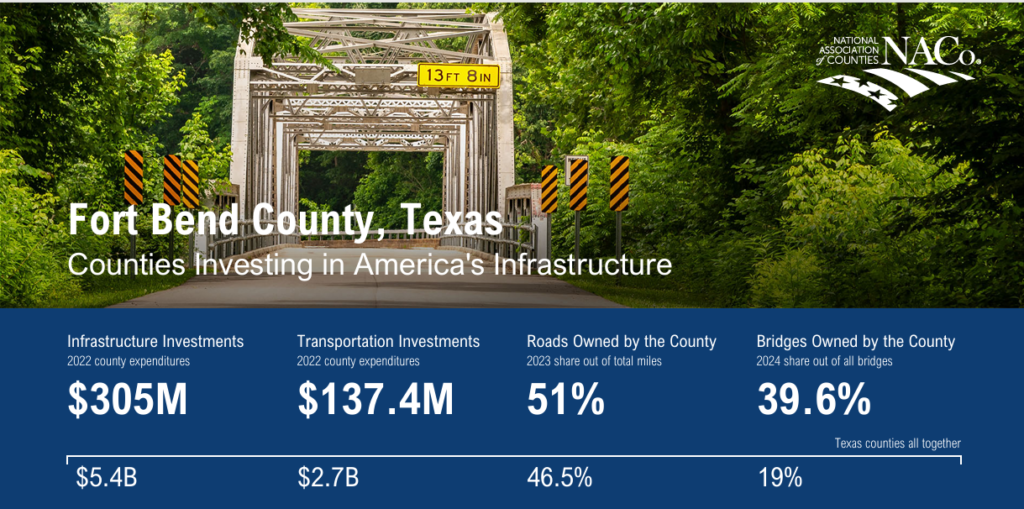
And infrastructure is expensive.
The challenge for government is not simply to build for today. It is to identify tomorrow’s needs early enough to plan, finance and deliver projects responsibly.
Federal programs are only one part of that equation, but they can represent a substantial part.
That is why county officials need to understand not only how much money Congress authorizes, but also:
How is it distributed? Who can access it? What local match is required? Who selects the projects? What restrictions accompany the money? And does the program recognize the infrastructure actually owned and maintained by counties?
Those details can make the difference between a federal authorization that looks good on paper and one that actually produces better infrastructure locally.
County Voices Need to Be at the Table
As a member of the Texas Association of Counties Core Legislative Group and the County Treasurers’ Association of Texas Legislative Committee, I believe one of the most valuable parts of attending conferences like this is gaining a better understanding of legislation while it can still be shaped.
County officials see policy from a perspective lawmakers may not always see.
We understand what happens after the legislation passes—when the funding has to be budgeted, the grant administered, the project financed, the invoices paid, the reporting completed and the infrastructure maintained for decades afterward.
That operational perspective belongs in the conversation.
The House proposal contains several encouraging provisions for counties, along with areas where NACo and county officials believe improvements are still needed. And with the September 30 expiration of the existing authorization approaching, the next several weeks will be important.
The road ahead is not simply about Washington.
It is about the roads and bridges our residents drive every day—and making sure Texas counties have a meaningful voice in the policies and investments that help maintain them.